Shipped
Campaign Management & Analytics Platform
I designed a unified Campaign Management & Analytics Platform for Major hospitality Brand that replaced multiple third-party tools, enabling marketing teams to create, personalise, schedule, and analyse campaigns in one place - reducing campaign creation time by 40% and significantly improving performance visibility.
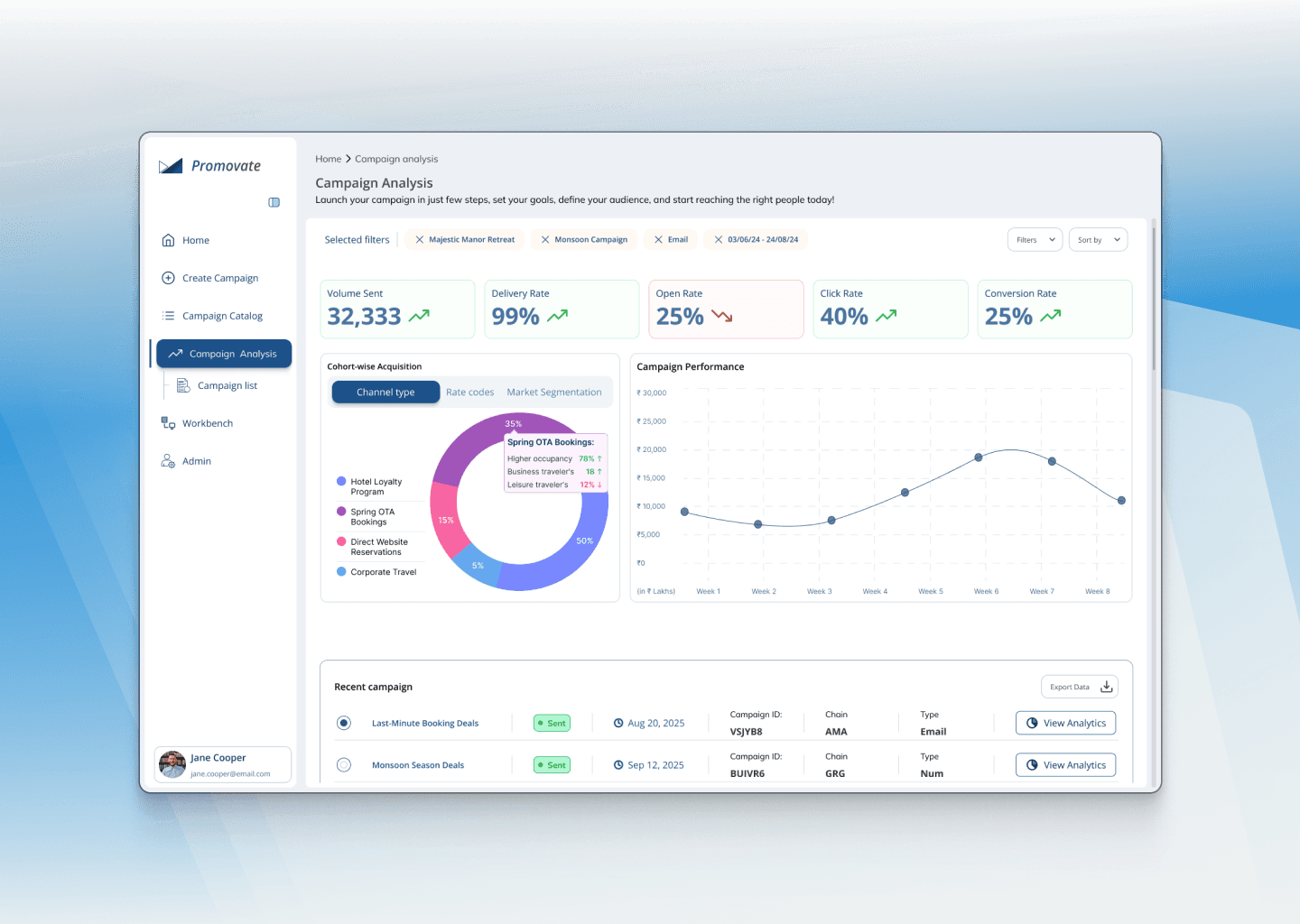
IHCL relied on multiple disconnected tools like Google Campaign Manager, Google Analytics, and internal spreadsheets to manage their marketing campaigns. This created silos, manual work, and lack of visibility into performance.
To solve this, I designed a unified web-based Campaign Management & Analytics Platform that brought campaign creation, targeting, scheduling, and analytics together in one system.
The platform enabled:
Marketing teams to create, personalize, and A/B test campaigns with advanced segmentation.
Analysts to directly access insights through an embedded Jupyter Notebook with agentic AI.
Executives to track campaign performance in real-time with unified dashboards.
The result? A tool that not only streamlined workflows but also reduced campaign creation time by 40%, improved visibility across brands, and empowered teams with scalable design systems for future growth.
Company
IHCL
Industry
Hospitality
My role
Product Designer
Timeline
5 Months
Team
Data Scientists, Engineering Team, Product Designer, UI/UX Designer
Problem Statement
IHCL was relying on multiple disjointed tools - Google Campaign Manager, Google Analytics, and Excel trackers to run marketing campaigns across its sub-brands. This created major friction in the workflow:
Time lost in switching tools → Campaign setup was slow and error-prone.
Limited personalization → Teams struggled to segment and target effectively.
Fragmented performance data → ROI tracking and optimization lacked clarity.
Dependence on analysts → Marketers couldn’t act quickly without waiting for deep-dive reports.
The lack of a unified system meant missed opportunities, delayed campaigns, and inefficiencies at scale.
The real challenge wasn’t about designing another dashboard. It was about creating a unified, scalable platform that simplified complexity for both marketers and analysts while directly improving speed and campaign ROI.
The Solution
I designed a unified Campaign Management & Analytics Platform that brought all campaign workflows into one place from planning and targeting to scheduling, A/B testing, and performance tracking.
Key aspects of the solution:
One platform for everything → Replaced 3+ disjointed tools with a single interface.
Step-by-step campaign builder → Guided flow to create and launch campaigns faster.
Advanced segmentation & personalisation → Easy-to-use targeting tools for marketers without needing analysts.
Real-time performance dashboards → Unified view of campaign ROI, engagement, and customer behavior.
Embedded Jupyter Notebook → Gave analysts direct access to AI-driven insights for deeper analysis.
Scalable design system → Created reusable components to maintain consistency and accelerate future development.
The goal wasn’t just to design “another marketing tool,” but to help IHCL cut campaign creation time by 40% and give teams real visibility into performance empowering marketers to act faster, with confidence.
Research & Insight
Given the project timeline, we focused on lean research to quickly understand IHCL’ marketing workflows and pain points.
What I did:
Stakeholder discussions → Collaborated with marketing managers and analysts to identify how campaigns were being created, scheduled, and tracked across multiple sub-brands.
Competitive scan → Reviewed existing tools like Google Campaign Manager, Google Analytics, and Mailchimp to benchmark features, but also noted how their fragmented usage created silos.
Workflow mapping → Documented the current “as-is” process, highlighting inefficiencies such as:
Switching between multiple platforms to complete one campaign.
Limited visibility into performance once campaigns went live.
Dependence on analysts for segmentation and insights.
Key insights gathered:
Marketers needed autonomy to run campaigns without always waiting for data teams.
Campaign creation was too time-consuming, with repetitive steps across tools.
Analytics were scattered and hard to interpret, slowing down decision-making.
These insights helped me focus on designing a guided, integrated workflow that reduced tool-hopping and gave marketers real control while still supporting data analysts with deeper insights.
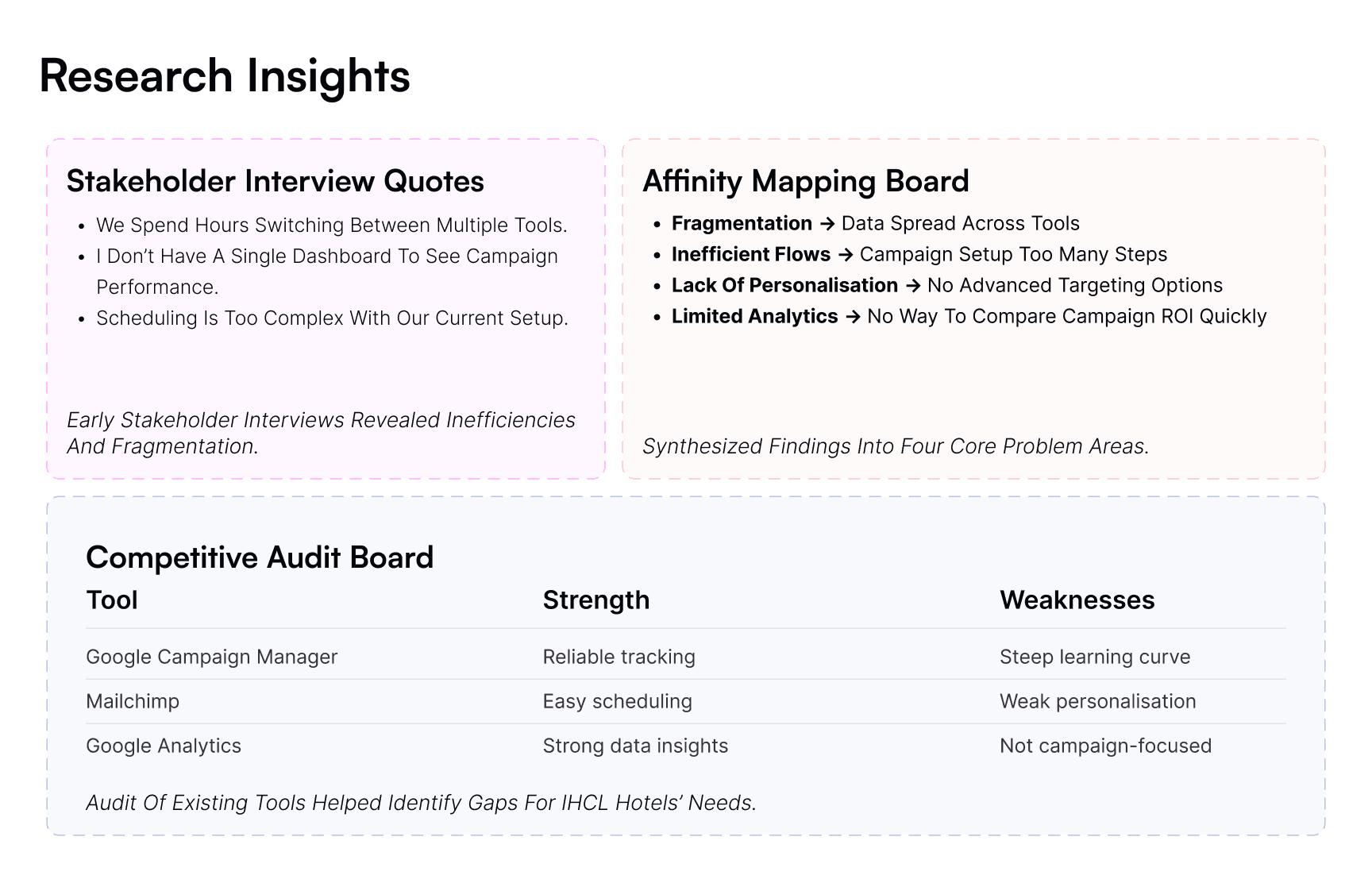
Early stakeholder interviews revealed inefficiencies and fragmentation.
Ideation & Process
With clear pain points in hand, I shifted focus to designing a unified platform that could replace multiple tools and guide marketers through campaign creation, targeting, and analysis.
How I approached it:
User Flow Drafting
Sketched the end-to-end journey for marketers: from campaign setup → targeting → personalisation → scheduling → analytics.
Created parallel flows for data analysts, who needed access to advanced insights and an embedded Jupyter Notebook interface.
Wireframing (Low → Mid Fidelity)
Started with quick sketches to align with stakeholders on the step-by-step campaign builder.
Iterated into low-fi wireframes to validate the navigation structure (Dashboards, Campaign Builder, Audience Segmentation, Analytics).
Conducted feedback rounds with marketing managers to ensure terminology matched their workflows.
Design Principles I Followed
Guided, not overwhelming → Stepper-based builder to break down campaign setup into digestible steps.
Clarity in complexity → Visual hierarchy and progressive disclosure to surface details only when needed.
Consistency at scale → Defined a mini design system early (colors, typography, button states) to accelerate later UI work.
Early Testing & Iteration
Shared interactive wireframes with IHCL’ marketing team to validate flow.
Adjusted builder steps based on feedback (e.g., moving segmentation earlier, since it was a critical decision point).
This stage ensured that the platform was not just replicating existing workflows digitally, but actually rethinking them for speed, clarity, and autonomy.
Design execution
Once the flows and wireframes were validated, I shifted to high-fidelity UI design, ensuring the platform felt both professional and approachable for marketers while maintaining scalability for OG Hotels’ future needs.
Key Deliverables:
Unified Dashboard
Designed a clean, card-based overview showing campaign performance, upcoming schedules, and quick actions.
Incorporated filters and drill-downs to give marketers at-a-glance insights without overwhelming them.
Step-by-Step Campaign Builder
Developed a 5-step builder: Objective → Segmentation → Personalisation → Scheduling → Review & Launch.
Used progressive disclosure so users only saw the information needed at each stage.
Added smart defaults and tooltips to reduce friction for first-time users.
Audience Segmentation & Targeting
Created an intuitive filtering system with checkboxes, sliders, and tags to allow both simple and advanced targeting.
Highlighted audience size in real-time to help marketers understand the reach of their choices.
Analytics & Insights
Designed comparison charts for A/B testing performance.
Integrated visualisations for click-through rates, conversions, and campaign ROI.
Ensured data scientists could access raw data via the embedded Jupyter Notebook interface, without breaking the marketer-friendly experience.
Design System
Built a scalable component library with 150+ reusable UI elements.
Standardised typography, color palette, and iconography to ensure consistency across dashboards, forms, and reports.
Visual Style:
Minimal, grid-based layouts for clarity.
Subtle color coding to differentiate campaign stages.
Rounded corners and soft shadows to keep the tool approachable, avoiding the “cold” feel of many enterprise platforms.
The final UI struck a balance between business depth and usability enabling marketers to move faster while giving analysts the transparency they needed.
Lo-fi Wireframe
Here, you show how the ideas started as rough layouts, focusing on flow and hierarchy rather than visuals.
Wireframed the campaign builder to validate the 5-step flow.
Sketched multiple versions of the dashboard to compare data density vs clarity.
Iterated quickly in grayscale before committing to details.
Used wireframes in stakeholder workshops to align on structure.
Hi-fi Wireframe
Once the core flows were validated through wireframes, I translated them into high-fidelity designs that balanced scalability, usability, and brand consistency. These designs brought the campaign platform to life with a clean visual language and a reusable component system.
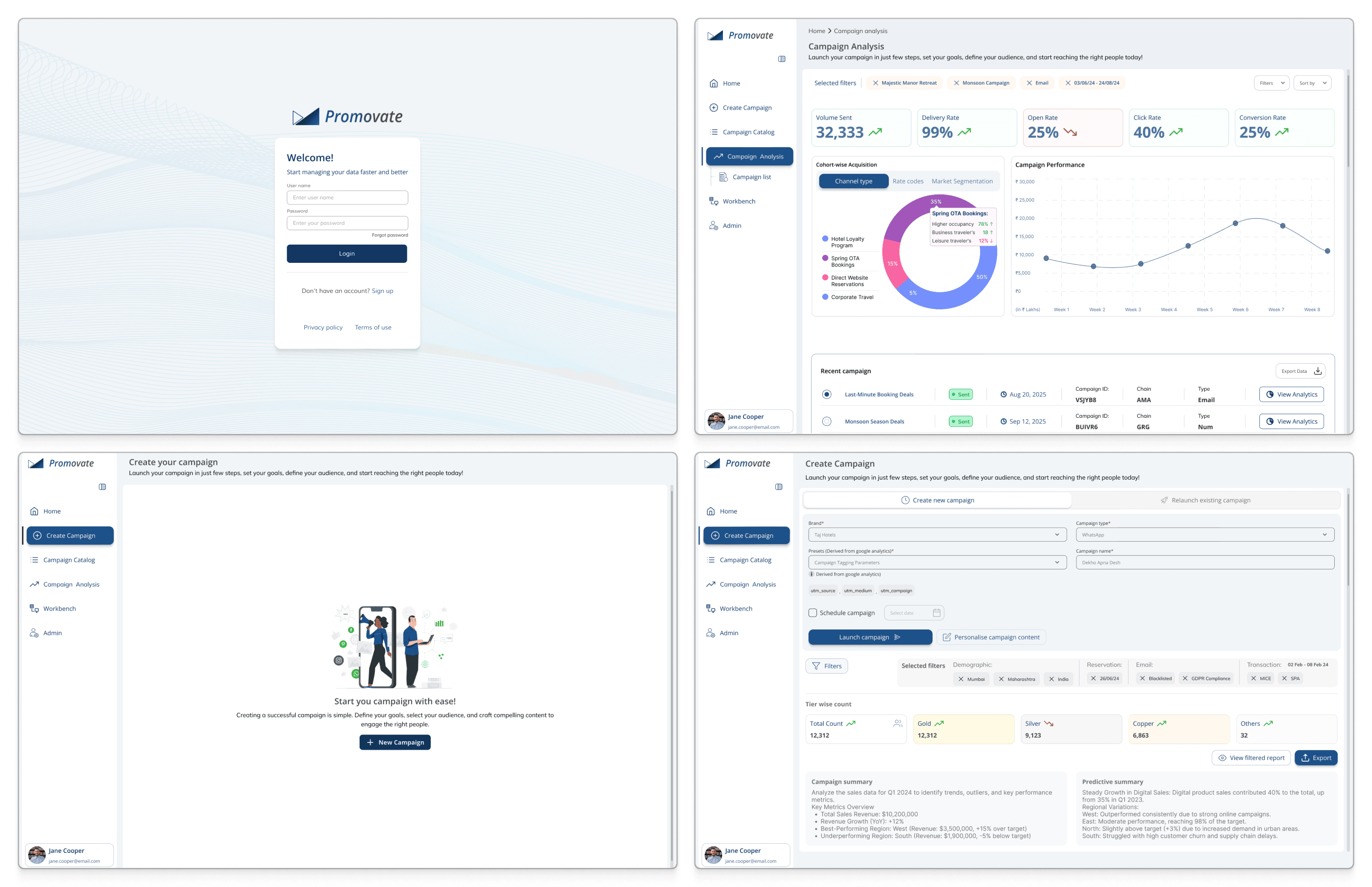
Final UI of campaign scheduling and analytics screens.
Usability testing & validation
To validate the designs, I conducted quick usability walkthroughs with the client’s marketing team. Since they were the primary users, their feedback was crucial in ensuring that the tool fit seamlessly into their daily workflows.
Campaign Builder Flow → Tested for clarity and speed. Feedback showed that step labels and progress indicators helped reduce confusion.
Segmentation & Targeting → Simplified filters were well received, though users requested preset segments, which were later added.
Analytics Dashboard → Users appreciated having campaign performance and ROI in one place, eliminating the need to switch between multiple tools.
This lightweight validation gave us confidence to move forward with development while keeping room for future iterations.
Final Outcomes & impact
The unified campaign management platform delivered clear value to OG Hotels:
40% faster campaign creation → Marketing teams could design and schedule campaigns in fewer steps compared to juggling 3+ separate tools.
Improved decision-making → Centralized dashboards gave leadership visibility into campaign ROI and engagement metrics in real time.
Consistency at scale → A design system ensured future campaigns and features could be added with minimal design–dev friction.
Positive user adoption → Early testers from the marketing team preferred the new platform over their older tools, citing ease of use and reduced context switching.
This project demonstrated how thoughtful design could streamline complex marketing workflows and directly contribute to business efficiency.
Key learnings
Looking back, the biggest challenge was balancing timelines with depth of UX exploration. Because the project ran for just under 4 months, a significant portion of the effort went into design execution and alignment with engineering.
If I had more time, I would:
Expand user research — Run structured usability studies with a wider group of marketers across different sub-brands to uncover more nuanced workflow needs.
Iterate on personalization features — Explore deeper targeting and automation capabilities to push campaign efficiency further.
Refine AI integration — Collaborate closely with data scientists to make the AI-driven insights feel more transparent and trustworthy to end-users.
Every project is a learning curve, and this one reinforced how design can deliver strong impact even within real-world constraints.